
'It was like rigorously preparing for a solid, good exam...' 'I don't know what marks I will get, but I felt the rigorous preparation of an exam.' 'You may sweat, but I feel rejuvenated.'

'I am doing the drive in making sure that people pass this on. So the drive is not with distrust. The drive is just in case.' 'Just in case it doesn't get passed on, I am here.'

'That is going to have an impact on literally every one, whether you buy a toothpaste, a safety pin, a car, shoes or medicines or you go to a diagnostic centre.'
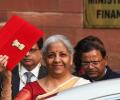
'... that it once again shies away from renewing its commitment to strategic divestment,' points out A K Bhattacharya.

If the fiscal deficit target of 4.9% of GDP has to be met for 2024-2025, which the government must in view of the uncertainties and challenges emerging both domestically and globally, the finance ministry may see in the composition of the current year's capex a sliver of hope, notes A K Bhattacharya.
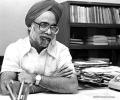
What stood out in his 15-year journey as a member of the political executive at the Centre was his glowing record as India's most successful and effective finance minister. Both as prime minister and finance minister, he understood the importance of gradualism, except when the economy or the polity was in a crisis.

Perhaps because the Modi government had some differences of opinion with two of the economist governors (one of whom was appointed by the Manmohan Singh government), there is a view that its political leadership prefers a civil servant to head the RBI, notes A K Bhattacharya.

A freebie once granted can hardly be discontinued. All that can happen is to substitute it with a bigger freebie, notes A K Bhattacharya.

'While investors need to be prepared for making some losses, they should not lose big money chasing euphoria amid fear of missing out.'

'It would be reasonable to assume that Modi 3.0 would be more focused on projects and schemes which do not require any legislative change or which have the support of its coalition partners,' asserts A K Bhattacharya.

Why did the political system in the country react to these two decisions of the Modi government in a diametrically opposite manner? asks A K Bhattacharya.

Dr T V Somanathan is the first finance secretary to be appointed Cabinet secretary since 1985. His appointment at this juncture seems to carry much meaning for the forthcoming trajectory of reforms and restructuring of India's steel frame.

Few finance ministers announce any taxation measure that could upset the stock market. Ms Sitharaman decided to take that risk, observes A K Bhattacharya.
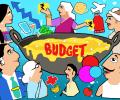
'We have essentially tried to set out an agenda for the next five years and it, in essence, represents the political commitment to that agenda.'

With the fiscal deficit target staring at the government, the FY25 Budget has limited expenditure options, points out A K Bhattacharya.

The Budget should use the extra RBI surplus to better effect, suggests A K Bhattacharya.
If the concerns over risking political capital are overcome, the long-term gains for the Indian economy will be immense, asserts A K Bhattacharya.

No government in the past initiated the process of policy making for its next tenure even before going in for elections. Once the Model Code of Conduct is enforced by the Election Commission, should the government of the day refrain from taking an active interest in policy making for the next five years and let that be the function of the new government?, asks A K Bhattacharya.

The new government that presents the full Budget for 2024-2025 in July should be ready to restructure the way divestment is managed and implemented, proposes A K Bhattacharya.

Questions will be raised over why those changes take place and whether non-economic factors are at play, says A K Bhattacharya.
